Picking the wrong fishing apparel manufacturer doesn't just cost you money — it costs you your launch timeline, your brand reputation, and sometimes the entire first season.
Most buyers walk into supplier conversations with little more than a product sketch and a price target. Then they wonder why their custom tournament fishing shirts arrive with faded sublimation prints, no verified UPF rating, and salt-water resistance that dies after one trip. This checklist changes that.
It covers five procurement phases — from filtering a vendor list down to locking in a long-term production partner. You get 25+ specific evaluation criteria, industry benchmark numbers you can quote back to factories, and 10 conversation-ready questions. Those questions separate the specialists from the generalists before you spend a single dollar on samples.
Phase 1: Initial Supplier Screening & Capability Verification
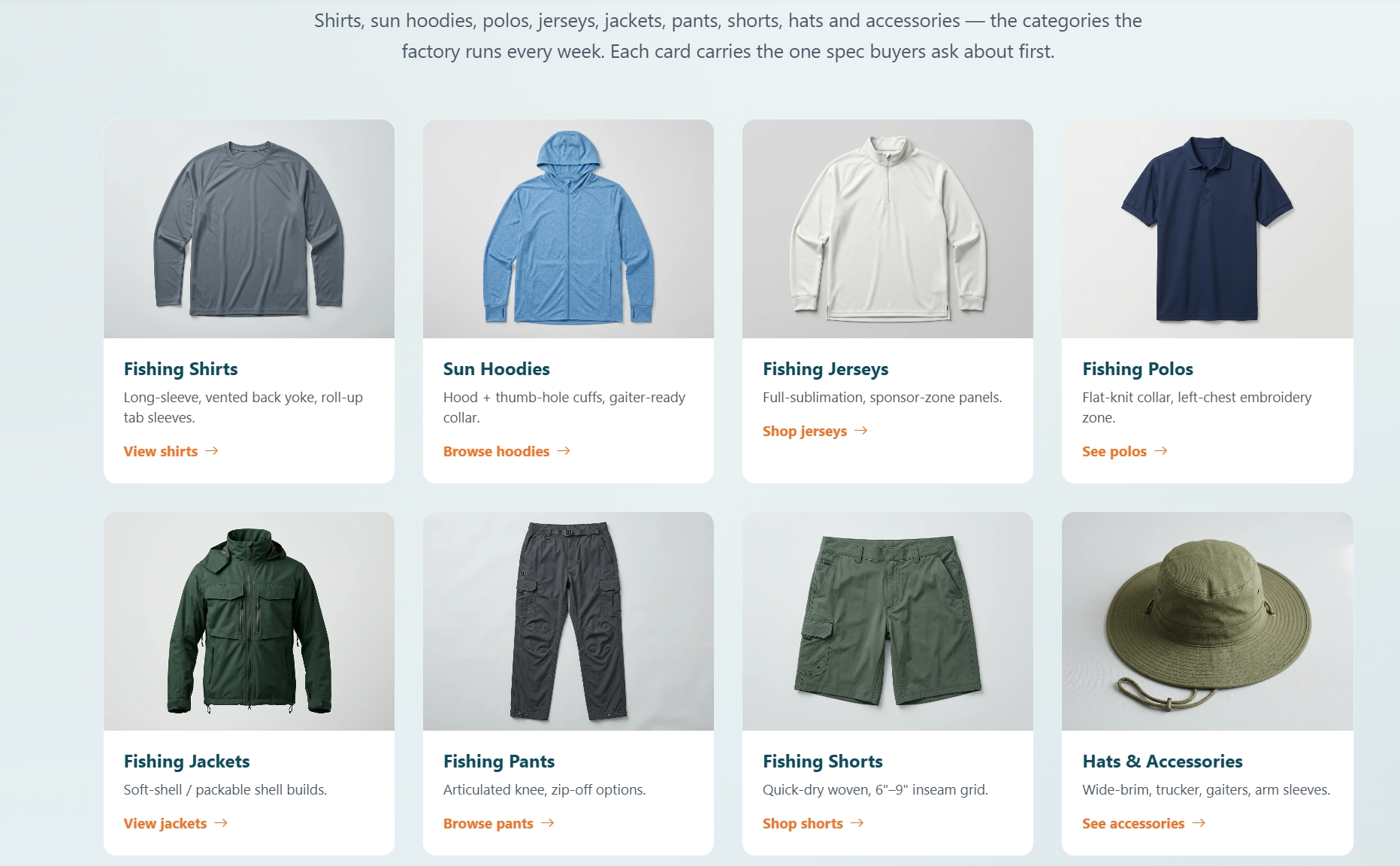
Here's the hard truth about fishing apparel sourcing: 80% of factories on any shortlist will waste your time. Phase 1 cuts that number fast — before you spend a single hour on detailed negotiations.
Think of this as a binary pass/fail filter across five non-negotiable criteria. A fishing apparel factory either clears the bar with verifiable proof, or they're off the list. No exceptions. No gut feelings.
Checkpoint 1: Verified Category Experience
Generic apparel factories will tell you they make "everything." What you need is a specialist who truly understands why UPF sun protection fishing shirts require different construction logic than a basic polo. That knowledge gap is real, and it costs you money.
What to request:
- A written company profile showing their founding year plus years focused on fishing or outdoor performance apparel
- A product category list that names these directly: fishing shirts, fishing jerseys, technical sun-protection wear
Benchmark: Look for a minimum of 3–5 years focused on fishing or performance outdoor categories — not general sportswear.
🚩 Red Flag: Their catalog is 90% fast-fashion tees and generic hoodies with a "fishing" category tacked on at the end.
✅ Green Flag: They send unsolicited photos of sublimation printing fishing jerseys with visible UPF labels, mesh ventilation panels, D-rings, and rod holder pockets. That's a factory that knows what they're doing.
Checkpoint 2: A Client Portfolio You Can Verify
Any factory can claim to have worked with "big brands." Very few will hand you three client contacts and say, "Call them."
What to request:
- 3–5 brand clients you can check — company names, websites, contact emails
- Case study photos tied to tournament gear, charter fleet uniforms, or e-commerce fishing lines
Cross-check their website and social media yourself. Do you see real custom tournament fishing shirts in use? Real team photos? Or just stock images pulled from Alibaba?
🚩 Red Flag: References are vague — "a US brand," "an Australian company" — with no contact details you can confirm.
✅ Green Flag: They give you a client list with active websites and fishing-specific products you can trace straight back to their production floor.
Checkpoint 3: Technical Performance Capability
This is where most generalist factories fall apart. A solid OEM fishing clothing factory quotes performance specs without hesitation. No stalling, no vague answers.
For moisture-wicking fishing clothing and sun shirts, ask for:
- Fabric GSM and fiber composition in their standard tech packs
- UPF 50+ ratings backed by third-party test reports (AATCC 183 standard)
- Proof of moisture-wicking finishes, flatlock seams, and mesh panel construction
For outerwear and fishing jackets, push further:
- Waterproof rating (≥20,000 mm for premium builds)
- Breathability rating (≥15,000 g/m²/24h)
- DWR treatment confirmation
Key question to ask directly:
"Can you share colorfastness test results and UPF test reports from a recent production run of quick dry fishing garments?"
A specialist sends those documents fast. A generalist stalls, changes the subject, or forwards a fabric supplier's spec sheet instead of their own production records. You'll know the difference right away.
Checkpoint 4: MOQ, Pricing Transparency & Export History
Fishing apparel MOQ requirements shift by product type. Here's the industry baseline for Asian OEM production:
Product Type | Typical MOQ Range |
|---|---|
Dye-sublimation fishing jerseys | 100–300 pcs/style/color |
Woven/knit fishing shirts | 100–300 pcs/style |
Complex outerwear (taped seams, multi-fabric) | 200–500 pcs/style |
A factory quoting below 50 pcs with no surcharge, or above 500 pcs as a baseline for basic jerseys, deserves a closer look — in both directions.
On pricing, require a fully itemized quotation that breaks out each cost separately:
- Fabric cost (GSM and composition specified)
- Trims and accessories
- CMT (cut-make-trim) labor
- Sublimation printing or embroidery charges
- Packaging (polybags, hangtags, carton)
- Trade term stated outright: EXW / FOB / CIF with port name
🚩 Red Flag: A lump-sum "all-in" price with zero breakdown. You can't see where costs climb as you scale. That signals a factory not set up for serious private label fishing apparel production.
For export history, ask for a 12–24 month shipment summary: destination country, product type, volume. Set a clear benchmark — at least three distinct export markets across North America, EU, or Australia.
Checkpoint 5: Communication Speed & System Reliability
Production problems rarely start with bad fabric. Most start with miscommunication that builds over weeks until something breaks.
Non-negotiable standards:
- A dedicated English-speaking project manager with real technical vocabulary — they should know AQL, GSM, FOB, and Delta E without you explaining each term
- Response time of 24 hours or less on business days
- A full written quotation delivered within 48 hours of receiving a clear tech pack and quantity range
Early test: Send a structured RFQ on Day 1. Track three timestamps — time to acknowledge, time to answer all questions, time to deliver a full quote. That first response tells you everything about how they'll handle a 300-piece production run with a fixed ship date.
🚩 Red Flag: Responses arrive in fragments across three days. Key questions get skipped. The "quotation" is one line item total.
✅ Green Flag: A timestamped, itemized quotation lands within 48 hours. It's signed off by a named contact who also confirms their compliance certification status and outdoor performance fabric sourcing procedures — without you asking twice.
Phase 1 Scorecard: Go / No-Go Decision
Run this scorecard for every factory before moving anyone to Phase 2:
Evaluation Area | Weight | Min. Passing Score |
|---|---|---|
Fishing-specific track record | 25% | ≥20/25 |
Export compliance & certifications | 20% | ≥15/20 |
Product line & technical capability | 25% | ≥20/25 |
MOQ & pricing transparency | 15% | ≥12/15 |
Communication quality & speed | 15% | ≥12/15 |
Overall threshold: ≥75/100. Any factory that scores below that number gets cut. Same goes for any factory flagged on even one critical issue — evasive communication, hidden pricing, or no UPF test documentation. Your Phase 2 shortlist should hold no more than three suppliers.
Phase 2: Deep Dive into Functional Fabrics & Pattern Engineering
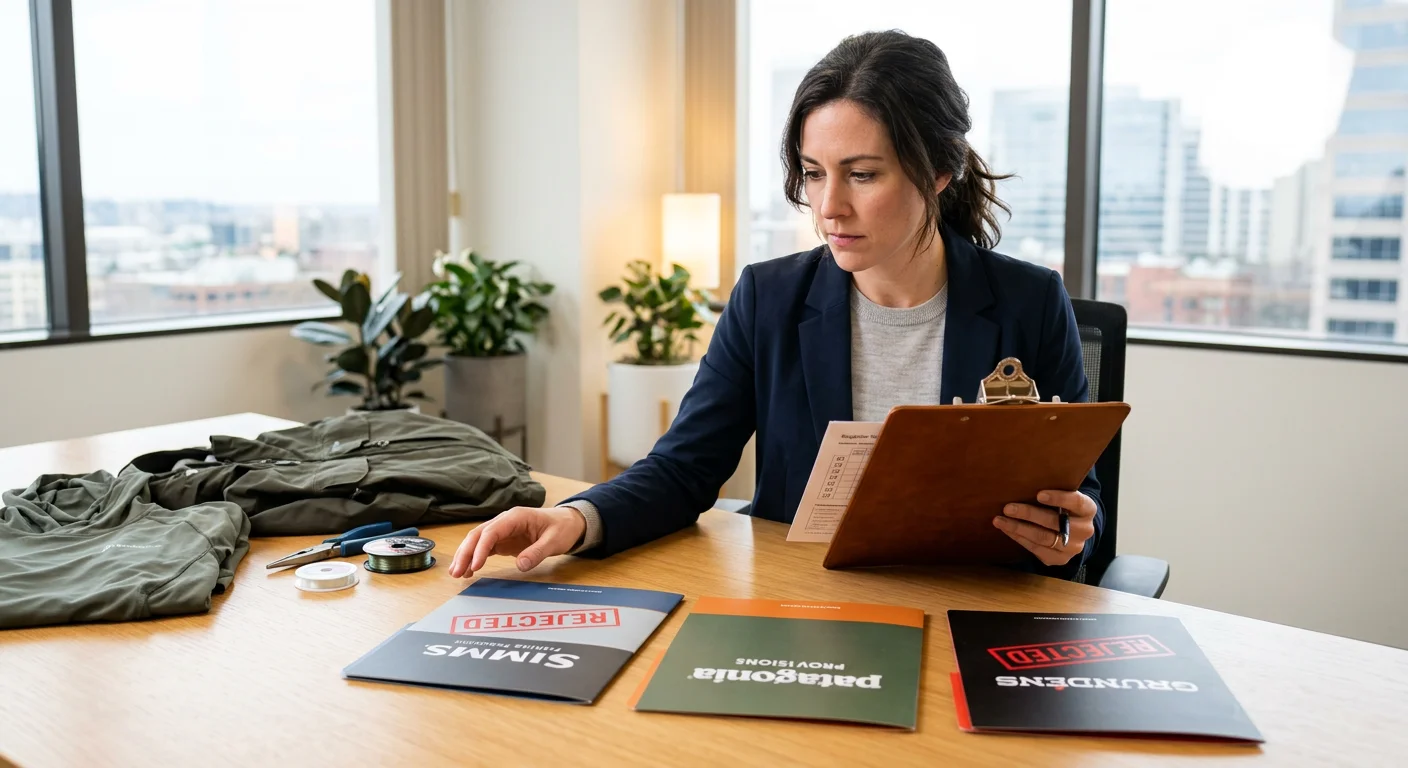
Your Phase 1 shortlist has three factories on it. Now the real separation begins.
This phase is where generalist factories expose themselves. Ask a standard apparel factory about UPF transmission under wet conditions — you'll get silence. Ask a specialist, and they'll send you accredited lab reports within the hour. That gap in response quality is your most reliable buying signal.
Work through these six checkpoints one by one. Each maps to a failure mode that kills fishing apparel brands in their first season.
Checkpoint 6: UPF Testing — Verify the Standard, Not Just the Claim
"UPF 50+" printed on a hangtag means nothing without lab data behind it. The correct testing standard for UPF sun protection fishing shirts is AATCC TM 183 . UPF categories are calculated using the AS/NZS 4399 framework and labeled per ASTM D6603 levels.
What to demand from every factory:
Accredited lab reports citing AATCC TM 183 by name — not a fabric supplier's marketing sheet
Reports showing both dry-state and wet-state test readings. Wet testing requires fabric soaked to 150% ± 5% moisture content before measurement
Separate test records for each colorway and each fabric panel used in the garment. Multi-color fishing shirts must be tested across all zones
Minimum performance benchmark:
- UPF 50+ rating (≥98% UV blocked)
- UVA and UVB transmission both ≤ 5% across the tested spectrum
- Numerical UPF value reported (e.g., "56"), not a range
🚩 Red Flag: The factory sends you a fabric mill's generic UPF certificate. It doesn't reference your specific production sample, colorway, or garment construction.
✅ Green Flag: They provide a full lab report with UPF value, average UVA transmittance, average UVB transmittance, and blocking rates — tied to the exact fabric lot being quoted.
Checkpoint 7: Moisture Management — Test the Whole Garment, Not Just the Swatch
Moisture wicking fishing clothing lives or dies on two numbers: wicking distance and dry time. A factory that tests fabric swatches in isolation — and nothing else — is hiding something.
Industry benchmarks you can quote:
Performance Metric | Minimum Standard |
|---|---|
Vertical wicking distance | ≥ 50 mm in 30 seconds (ISO wicking protocol) |
Dry time (full garment) | ≤ 30–40 minutes from saturated to comfort-dry |
One-way transport index (AATCC 195) | Higher inner-to-outer surface value |
Fiber and finish both matter here. Polyester/nylon blends with engineered multi-channel cross-sections outperform basic polyester every time. Ask whether the hydrophilic finish holds through 30 wash cycles. Fast-fashion factories use surface treatments that break down after just five washes.
Key question to ask:
"Can you provide AATCC 195 test reports showing one-way transport index data, plus a timed drying test on full garment weight — not a fabric sample?"
🚩 Red Flag: They claim "quick dry fishing garments" but provide a single fabric swatch test with no wash-durability data on the finish.
✅ Green Flag: Full AATCC 195 report with wicking distance curves, documented fiber content (e.g., "88% polyester / 12% nylon"), and a stated finish durability benchmark like "hydrophilic wicking finish, durable for 30 washes."
Checkpoint 8: Saltwater & UV Durability — The Benchmarks Most Factories Skip
This checkpoint separates fishing-specific OEM fishing clothing factories from outdoor apparel generalists. Sun and salt degrade apparel in ways that basic colorfastness tests don't capture.
Mandatory test standards:
ISO 105-E10 : Colorfastness to seawater — minimum Grade 4 on a 1–5 scale (5 = no change)
ISO 105-X12 : Colorfastness to rubbing — critical for deck and boat-seat abrasion
Yarn specification: solution-dyed polyester or high-tenacity polyester in all high-exposure zones (shoulders, back yoke, sleeve tops) — avoid basic piece-dyed polyester in these areas
Hardware matters just as much as fabric. Confirm:
- Zippers are YKK Vislon or equivalent corrosion-resistant plastic coil — no standard metal sliders in salt-exposed positions
- All stitching uses 100% polyester thread — cotton-wrapped threads break down fast under salt and UV cycling
- Cuff and hem elastics are chlorine- and salt-resistant spandex blends with protective sheathing
🚩 Red Flag: The factory specifies "standard polyester" without yarn type, finish, or colorfastness grade. No seawater ISO test report is available for their existing fishing line.
✅ Green Flag: ISO 105-E10 and lightfastness reports show ≥ Grade 4. You also get documented yarn type ("solution-dyed 150D polyester") and confirmed YKK trim specifications — delivered without you having to ask twice.
Checkpoint 9: Pattern Engineering for Casting Motion
A factory can source perfect outdoor performance fabric and still ruin the garment at the pattern stage. Fishing-specific pattern engineering is non-negotiable for custom tournament fishing shirts . Most generalist factories don't carry these details in their block library.
Four structural features that must be documented in every tech pack:
Articulated sleeves — pre-curved elbow and forearm seams aligned to casting and rod-hold position
Yoked back panels — shoulder/back yoke for structural stability, with integrated mesh venting that doesn't restrict shoulder rotation
Gusseted underarms — triangular or diamond gussets allowing full overhead casting, paddling, and net-throwing without hem lift
Shaped hem with side slits — designed to accommodate torso flexion in seated boat and kayak positions
Fit testing benchmark: Require at least one documented wear-test round per size run. Fit models must perform overhead casting, rowing, net throwing, and seated reach — no binding at scapula, underarm, or elbow. The hem must not expose the lower back on overhead reach.
Pattern grading must align to US/EU/AU sizing standards with documented chest ease values. Standard relaxed fishing shirts run 8–12 cm chest ease — confirm this is built into their grade spec, not estimated on a dress form.
🚩 Red Flag: Their tech pack shows a standard sport shirt block with no gussets, no articulation notes, and sizing referenced to one regional standard only.
✅ Green Flag: The tech pack includes schematic diagrams of gussets and yoke construction, graded measurements per size for multiple markets, and a documented motion-range test log from a previous fishing collection.
Checkpoint 10: Fabric Sourcing Network & Mill Certification
The best factories don't just process fabric — they control their supply chain knowledge. For outdoor performance fabric sourcing , look for a factory that keeps a live swatch library tied to verified mill documentation. Avoid any factory that re-sources from different mills each season with no tracking.
Target mill profile for fishing-specific production:
- High-UPF woven synthetics (poly/nylon blends, AATCC 183 certified)
- Lightweight quick-dry knits with AATCC 195 data on file
- Reinforcement fabrics for abrasion zones — Cordura or high-tenacity equivalent
Certifications to require from mill documentation:
- AATCC 183 / AS/NZS 4399 UPF certificates
- ISO 105 colorfastness and seawater resistance reports
- AATCC 195 or ISO wicking test data
- OEKO-TEX® Standard 100 certification for skin-contact safety — relevant for fishing shirts worn against skin in hot conditions
Ask whether the factory requires fresh test reports whenever dye recipes or finishing lines change . A well-run operation treats a recipe change as a re-certification trigger. Not a formality.
🚩 Red Flag: Their swatch library hasn't been updated in over a year. They can't link specific fabrics to specific product lines or confirm which mill produced which test report.
✅ Green Flag: They maintain a quarterly-updated swatch library with UPF grade, wicking grade, salt/UV durability grade, handfeel rating, and cost per fabric — organized by product line (e.g., "Offshore casting shirt," "Inshore guide shirt"). That's a factory running a professional private label fishing apparel development process, not a cut-and-sew commodity operation.
Phase 2 Gate: What Passes to Phase 3
By the end of Phase 2, you should have cut at least one more factory from your shortlist. Any supplier that can't produce accredited UPF lab reports, wet-state test data, ISO seawater colorfastness results, and a motion-engineered tech pack is not ready for serious fishing apparel production. Competitive pricing doesn't change that.
The two or three factories that clear this gate move into sample validation with a clear technical brief in hand. That's Phase 3.
Phase 3: Sample Development & Consistency Benchmarking
Two factories made it here. Now you find out which one delivers what they promise.
The sample phase is where fishing apparel sourcing gets real. Sublimation prints ghost at the seams. Moisture-wicking finishes fail their first wash test. UPF ratings turn out to be fabric-supplier marketing copy — not garment-level lab data. Your job in Phase 3 is to run a controlled, documented approval process. Not a casual "looks good, let's go" exchange.
Work through these checkpoints in sequence. Each one targets a real failure mode.
Checkpoint 11: Hold the Sampling Timeline to a Firm Benchmark
Vague timelines turn four-week sample phases into three-month delays. Lock specific dates before a single sample ships.
The timeline you should demand:
Milestone | Maximum Lead Time |
|---|---|
Tech pack frozen → Proto request sent | Same day |
Proto sample shipped from factory | ≤ 10 calendar days |
Your fit comments returned to factory | Within 48 hours of proto receipt |
Adjusted fit sample shipped | ≤ 7–10 days from comment receipt |
Pre-production sample (PPS) shipped | ≤ 3–7 days after final fit approval |
Total sample phase: 3–4 weeks. That's the industry benchmark for custom tournament fishing shirts built on an existing performance block. A factory quoting six weeks for a straightforward sublimated jersey — with no complex construction — has a disorganized sampling floor.
Two conditions make the 10-day proto target work: the performance knit fabric (polyester/nylon blend, standard stock) sits in mill inventory already, and sublimation print files are finalized before you submit the tech pack. Don't move to proto with an "almost ready" artwork file.
🚩 Red Flag: The factory needs two weeks just to "review" your tech pack before giving you a proto ship date.
✅ Green Flag: They respond within 24 hours with a dated sampling milestone sheet — proto date, fit sample date, and PPS date all confirmed.
Checkpoint 12: Define the Golden Sample Before Production Starts
The pre-production sample (PPS) is not a formality. It's the binding production reference. Every QA decision in bulk production traces back to this one garment.
What the PPS must contain to be valid:
Produced from actual bulk materials — not development or lab-sourced lots
Unique ID tag referencing: fabric lot/batch ID, sublimation print run ID (including ICC profile), and trim batch codes for zippers, labels, and heat transfers
A mutual sign-off sheet — both brand and factory sign — covering:
Final measurement chart vs. actual PPS measurements (tolerances listed per point of measure)
Confirmed fiber content, GSM, and finishing treatment with lot number
Print alignment references for front, back, and side panels — logo placement tolerance ±2 mm
Trim placement: zipper lengths, puller style code, label positions
Packaging specs: fold method, polybag dimensions, barcode label position
Storage protocol: One signed PPS stays in the factory QA lab as the sole production reference. You keep an identical signed copy. The Top of Production (TOP) sample — pulled from the first units off the line — must match the PPS in size and appearance. No exceptions.
Production does not start until both parties sign PPS approval. A factory that says they'll "start cutting while we wait for your sign-off" needs to be stopped.
🚩 Red Flag: The factory labels a development-fabric sample a "golden sample" and marks it approved — no lot numbers, no mutual sign-off sheet.
✅ Green Flag: The PPS approval sheet arrives pre-filled with fabric lot codes, trim batch references, and a clear note: "Production line hold pending brand sign-off." That's a factory running a serious private label fishing apparel operation.
Checkpoint 13: Color Accuracy — ΔE Numbers, Not Eyeball Approvals
Color consistency in sublimation printing fishing jerseys runs through two stages: digital proof approval before sampling, and strike-off approval before bulk. Both must happen in writing.
Quantitative benchmarks to hold:
Main body colors and brand logos: Delta E ≤ 1.5 (CIE Lab) vs. approved Pantone swatch or calibrated digital proof
Secondary prints and minor graphic elements: ΔE ≤ 2.0 maximum
Never accept a ΔE range. Require the exact numerical value in your approval documentation.
Sublimation-specific print quality standards:
Defect Type | Pass / Fail Threshold |
|---|---|
Banding (horizontal printer lines) | Zero tolerance |
White spots (unprinted areas) | Zero tolerance |
Ghosting (double image from movement) | Zero tolerance |
Seam misalignment (front-to-back graphic) | ≤ 3 mm |
Logo centering variance on chest | ≤ 2–3 mm from center line |
Bleed and registration requirements: All panel artwork needs a 2–3 mm bleed margin beyond the cut line. For raglan sleeves and multi-panel quick dry fishing garments , bleed calculations must cover fabric stretch and heat-press shrinkage — not just the flat pattern. Skip this step and graphic elements disappear into the seam allowance.
Lock pressing parameters in writing on the print SOP: temperature range (200–210°C), press time (45–60 seconds), documented by ink lot and paper lot. Any deviation in the next production run triggers a re-strike.
🚩 Red Flag: Color approval is a WhatsApp photo captioned "looks good?" No ΔE value. No lot reference. No strike-off on actual bulk fabric.
✅ Green Flag: The factory sends a formal color approval card with measured ΔE values, the specific Pantone reference used, ink lot number, and confirmation that pressing parameters are locked in their PPM.
Checkpoint 14: Wash Durability — Test the Finish, Not Just the Look
A sublimation print that looks sharp after sampling but breaks down after five washes is the most common first-season complaint in moisture wicking fishing clothing . These are the minimum durability standards to sign into your PPS approval sheet.
Benchmark standards by decoration type:
Decoration Method | Test Protocol | Minimum Performance |
|---|---|---|
Sublimation prints | AATCC 135 (home laundering) | 20+ cycles, no cracking, no peeling, colorfastness rating ≥4 on AATCC gray scale |
Heat-transfer logos / sponsor marks | 40°C wash cycles | 50+ cycles, adhesion intact, no edge lifting, colorfastness ≥4 |
Embroidery (name badges, club logos) | ISO/AATCC wash colorfastness | ≥4 rating after 20+ cycles, no fraying or stitch distortion |
For fishing-specific durability, add two tests that most generic apparel buyers skip:
Saltwater soak simulation: Soak the garment in saline solution, dry it, then wash it. Verify that print fading and finish degradation don't exceed the dry-wash benchmark.
Lightfastness: Run a minimum 20 hours of equivalent outdoor UV exposure. Check for no major color shift on primary jersey colors. This protects your UPF sun protection fishing shirts from fading in the on-water conditions your customers face every trip.
🚩 Red Flag: The factory points to a fabric supplier's generic wash test. No garment-level data. No saltwater or UV simulation. For a product built around outdoor exposure, that gap is not acceptable.
✅ Green Flag: They provide a wash durability report tied to the PPS — AATCC 135 cycles documented, grayscale rating per zone, and confirmation that saltwater and UV simulation ran on the same sample lot.
Phase 3 Gate: What Moves to Phase 4
One rule governs this gate: no Phase 4 without a fully signed PPS and documented color approval. Not "almost approved." Not "we're aligned on this." Signed, dated, lot-referenced documentation — in your hands and theirs.
A factory that resists the PPS sign-off process, won't document ΔE values, or can't produce wash durability data tied to actual garment samples is not a serious production partner for fishing apparel quality control . Move on.
The factory that clears this phase owns the production slot. That's Phase 4.
Phase 4: First-Order Trial & End-to-End Quality Control
The signed PPS is in your hands. The production slot is confirmed. Most buyers exhale at this point — and that's where first orders fall apart.
Phase 4 is not a passive waiting period. It's an active inspection sequence. It starts the moment fabric rolls arrive at the factory floor and ends when the container doors close. Miss one checkpoint here and you're not just fixing garments — you're rewriting your launch timeline.
Work through these five checkpoints in order. Each one maps to a real failure point that shows up in first-order audits for custom tournament fishing shirts and moisture wicking fishing clothing alike.
Checkpoint 15: Fabric Incoming Inspection — Don't Let Bad Rolls Reach the Cutting Table
Every quality problem that reaches your customer started as a fabric problem someone chose to ignore.
Run the 4-point inspection system per ASTM D5430 on every incoming lot:
Inspect 10–20% of rolls per shipment. For first-time mills or high-risk dye lots, go to 100% roll inspection
Acceptable defect ceiling: ≤ 40 points per 100 linear yards . Anything above this triggers rejection or a mill claim — not negotiation
Record on every roll: roll ID, batch ID, actual GSM (tolerance ±5% from spec), actual width (tolerance ±1.5 cm), shade group, and hand-feel rating against your sealed reference sample
Shade variation is where outdoor performance fabric sourcing breaks down fast. For UPF sun protection fishing shirts and sublimated jerseys, the color difference between lab-dip and bulk roll must stay at ΔE ≤ 1.0–1.5 . Segregate rolls by shade group before cutting begins. A shade band that looks close under fluorescent warehouse light will look wrong in open-water sunlight. Don't rely on visual checks — measure it.
Put a QR code label on every roll. Link it to: mill name, production date, batch number, fiber content, and test reports. That scan trail connects each roll to the finished garment and the carton it shipped in. A defect surfaces after delivery? Your investigation takes hours — not weeks.
🚩 Red Flag: Fabric arrives without roll IDs or batch documentation. The QA team eyeballs shade variation instead of measuring it.
✅ Green Flag: Every roll carries a scannable label. Shade readings are logged against the ΔE benchmark before any material touches the cutting table.
Checkpoint 16: In-Line Sewing Controls — Catch Problems at the Stitch, Not the Carton
Here's a number worth holding onto: defects found during in-line inspection cost about 1/10th what they cost to fix after final packing. That's the entire case for in-line QC.
Stitch standards for fishing-specific construction:
10–12 SPI on main seams for performance knits ( quick dry fishing garments , jerseys, sun shirts)
12–14 SPI on stress seams or fine wovens where specified in the tech pack
Bartacks required at: pocket corners, D-rings, belt loops, load-bearing tabs, sleeve cuffs, and hem-side seam junctions — minimum 3–4 bartacks per pocket
In-line monitoring frequency:
Run audits every 1–2 hours per sewing line , pulling 5–10 pieces per check
Critical defects hit ≥ 2–3% in any sample pull? Stop the line. Issue a Corrective Action Report (CAR) right away — don't flag it and keep going
Track machine maintenance in writing: needle changes every 8 hours or per 2,000–3,000 pieces , thread lot traceability, tension calibration records
First-piece confirmation must happen within 24 hours of line start — signed off by both QA and the production supervisor. The first complete garment off the line doesn't match your tech pack and PPS measurements? Nothing that follows it should ship.
🚩 Red Flag: In-line checks happen once per day, if at all. Defects are "noted" without triggering a line stop or a formal CAR.
✅ Green Flag: Hourly audit logs are on file. The factory's QA team can pull the defect rate trend for your style at any point during production — no scrambling to find the data.
Checkpoint 17: Mid-Production Pull — The Inspection Most Buyers Skip
At 30–50% of your PO quantity complete, pull a mid-production sample. This checkpoint catches pattern drift, print misalignment, and trim failures before they spread across the rest of the run.
Sampling benchmark:
Pull 10% of produced quantity at the mid-production stage
For a 500-piece first order, that means 50 pieces pulled and inspected — not skimmed
In multi-line production setups, pull at least 50 pieces per line to capture variability between operators
What to measure on every pull:
Measurement Point | Acceptable Tolerance |
|---|---|
Chest, body length, sleeve length | ±1.5 cm standard; ±1.0 cm for technical fits |
Print/graphic centering (CF/CB) | ≤ 5–8 mm misalignment depending on spec |
Zipper function | Pass 3–5 open/close cycles, no jamming |
Seam tape adhesion (waterproof styles) | No bubbles, no lifting at edges |
Measurement tolerance exceeds ±1.5 cm on more than 2–3% of inspected pieces? Issue a CAR. The CAR must document: defect description with photos, defect rate by size and color, root cause (pattern grading error, cutting tension, machine calibration), containment action (segregate affected WIP), and a follow-up re-sample of 5% of output after correction. That re-sample confirms the defect rate dropped below threshold.
This is how fishing apparel quality control works in a well-run factory. Not "we'll fix it before shipment." A documented loop with a verified close.
🚩 Red Flag: The factory treats mid-production sampling as optional on first orders. CARs don't exist in their process — problems get fixed off the record with no paper trail.
✅ Green Flag: Mid-production pull results land in your inbox with a defect code breakdown, dimensional log, and confirmation of corrective actions taken — or confirmation that zero CARs were triggered.
Checkpoint 18: Final AQL Inspection — The Numbers That Govern the Go/No-Go
Final inspection runs on AQL 2.5 for major defects / AQL 4.0 for minor defects using ANSI/ASQ Z1.4 sampling tables.
For a first-order lot of 3,201–10,000 pieces , the sample size is 200 pieces . Accept if major defects stay at 10 or fewer ; reject at 11 or more . Minor defects: accept at 14 or fewer , reject at 15+ .
Beyond dimensional and visual checks, run functional tests on your AQL sample:
Zipper test: Open and close 3–5 cycles per garment — no jamming, no tooth misalignment
Drawcord pull test: Use 10–15 kgf for 10 seconds at cord ends — no pullout, full elastic recovery at 30–50% extension
Pocket drain function (for wading or offshore styles): Pour 250–500 ml through the pocket and verify the drain hole clears clean
On top of AQL sampling, require 100% visual inspection before packing — loose threads clipped, no oil stains, no marks. Check packaging accuracy on every unit: correct size, color, and style per polybag, barcode label positioned per spec, carton weight within 20–25 kg maximum .
🚩 Red Flag: Final inspection is a factory self-audit with no third-party involvement and no formal AQL pass/fail record. Defects get described out loud rather than logged by category.
✅ Green Flag: AQL inspection report from SGS, QIMA, or Intertek arrives with lot size, sample size, defect statistics by category (Critical/Major/Minor), photos, and a clear Pass result — ready to attach to your shipment documentation.
Checkpoint 19: Shipment Documentation & Compliance Lock
Nothing ships without a complete document package. For private label fishing apparel entering the US, EU, or Australian market, that means:
Standard documents — all cross-checked against PO before release:
- Packing list with carton-wise breakdown: style, color, size, quantity, gross/net weight, CBM, carton ID linked to production batch
- Commercial invoice: unit price, total value, HS code, Incoterms, payment terms
- Certificate of Origin issued by an authorized authority, citing country of manufacture and HS code
Compliance declarations — required for every OEM fishing clothing factory relationship:
- REACH confirmation : no SVHCs above threshold; lab reports covering azo dyes and heavy metals
- CPSIA tracking label (US market, if applicable): lead and phthalates test reports, flammability documentation for applicable categories
- OEKO-TEX® Standard 100 certificate for skin-contact fabrics — relevant for performance fishing shirts worn against the skin
Build a test report matrix that links every style-color combination to its physical tests (seam strength, shrinkage, AATCC 183 UPF results) and chemical compliance results. That matrix is your audit defense if a customs authority or retail buyer requests documentation.
Final release rule: No shipment leaves until the AQL inspection passes, all CARs are closed on record, and every document is complete and cross-referenced. A factory that pushes for early release "while we sort the paperwork" is showing you how they handle problems under pressure. Take note of that.
Phase 4 Gate: What the Data Should Tell You
At the end of Phase 4, you hold a full paper trail — from roll ID to carton ID — covering every production decision made on your first order. That trail does three things: it's your quality defense if goods arrive with issues, your leverage when discussing Phase 5 scaling terms, and your benchmark for deciding whether this factory earns long-term OEM fishing clothing status.
Any factory that can't produce complete inline audit logs, a closed CAR record, a passed AQL certificate, and a full compliance document set has not cleared Phase 4. Price history and the relationship don't change that standard.
The factory that clears this gate with clean documentation owns your next production cycle. That's the one credential that matters.
Phase 5: Long-Term Partnership & Scalable Production Alignment
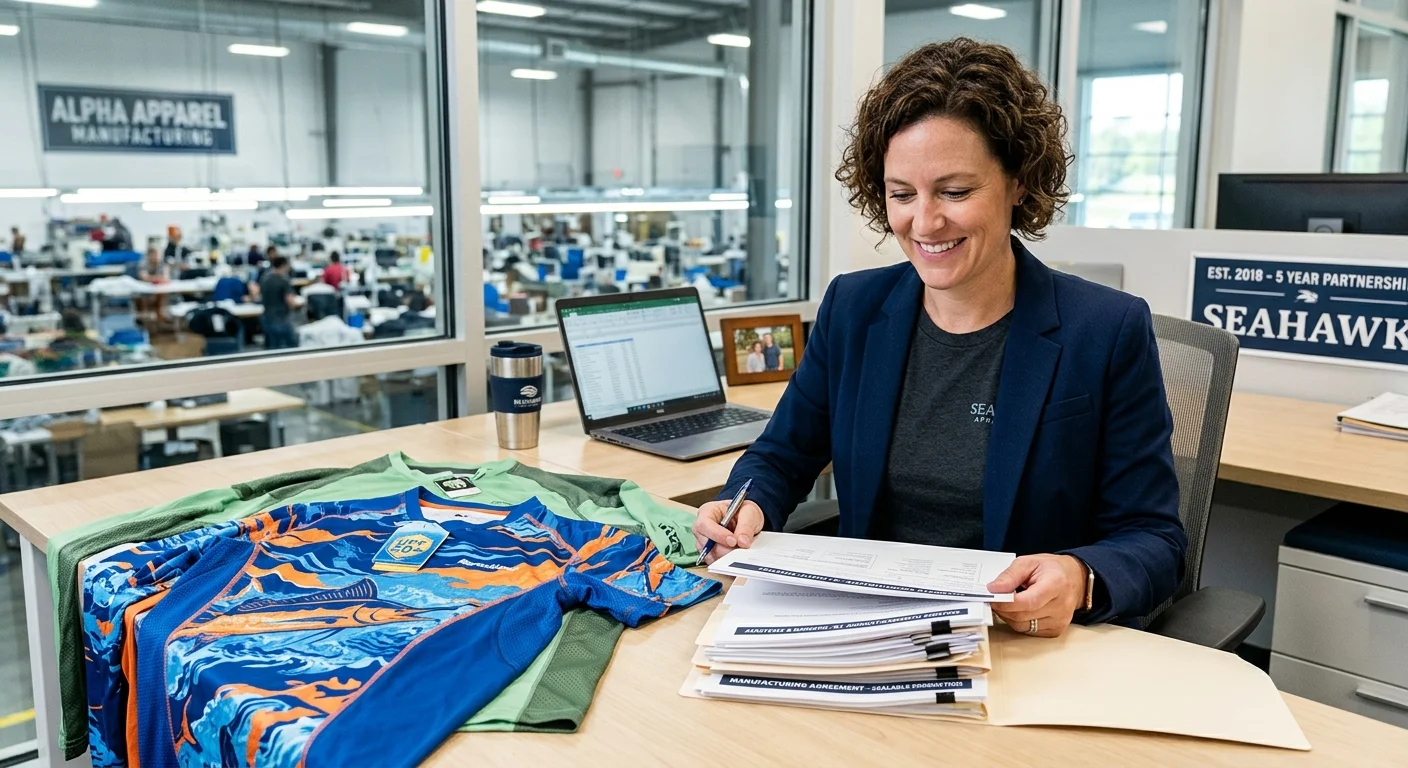
Your first order cleared Phase 4 with clean documentation. That tells you one thing: this factory can execute. What it doesn't tell you is whether they can scale with you. In fishing apparel, the gap between a reliable sample supplier and a true growth partner is exactly where most emerging brands stall out.
Phase 5 is about locking in structural agreements that protect your brand as volume climbs. These aren't handshake conversations. They're documented commitments with specific numbers attached.
Checkpoint 21: Capacity Reservation & Seasonal Ramp Planning
Fishing apparel runs on hard seasonal windows. Bass season. Tournament circuits. Spring retail drops. A factory that "should have capacity" in March is not the same as one under contract to hold it for you.
Production benchmarks to verify:
- A dedicated line handles 3,000–8,000 pcs/month on a single SKU. For peak seasons, confirm the factory can absorb a 5–10× volume increase within 3–6 months while keeping finished-garment defect rates below 1.5–2.0%
- Lead time must stay under 75 days even at peak load for repeat SKUs — not just 45–60 days at normal volume
What to require in writing:
- A capacity reservation addendum that defines your baseline slot (e.g., 500 pcs minimum) and peak ceiling (e.g., 5,000 pcs), with a locked fishing-season calendar
- A line-loading plan listing specific machines — sublimation press, coverstitch, bartack — plus a confirmed backup: a sister facility audited to identical standards, ready to handle overflow
🚩 Red Flag: "We'll prioritize you" with nothing in the contract. No reserved slots, no peak calendar, no backup plan.
✅ Green Flag: A signed capacity addendum arrives with March–June priority windows named, machine list attached, and a documented ramp example. It shows a previous buyer scaled from under 1,000 to over 5,000 pcs/month without defect rates exceeding 2%.
Checkpoint 22: Inventory & Safety Stock Agreements
Stock disruptions kill reorder cycles for quick dry fishing garments and UPF sun protection fishing shirts built on repeating fabrics. A mature OEM fishing clothing factory holds buffer inventory on your behalf — and documents it.
Safety stock benchmarks:
- 15–30% of forecast usage per month held at the mill or factory for core fabrics: quick-dry polyester, UPF mesh panels, ripstop nylon reinforcement
- Practical example: a core long-sleeve fishing shirt uses 0.8m of 120gsm quick-dry polyester at 5,000 pcs/month — that's roughly 4,000m needed per month. Your safety stock buffer should be 600–1,200m on hand, dedicated to your account
For recurring custom tournament fishing shirts and private label fishing apparel SKUs, push for a formal VMI (Vendor Managed Inventory) arrangement:
- You share a 12-month rolling forecast by SKU and colorway
- The factory holds a minimum 4–8 weeks of average demand and replenishes on a set schedule
- You get reports each month covering FIFO logic, lot/dye-batch tracking, and barcode or RFID warehouse management — this removes shade-mismatch risk from aging stock
🚩 Red Flag: No buffer stock policy. The factory re-sources fabric each season from different mills with no continuity tracking.
✅ Green Flag: A signed VMI agreement specifies minimum meters per fabric type, a set forecast review cycle each month, and clear liability terms for obsolete inventory.
Checkpoint 23: Continuous Improvement & Tech Pack Version Control
Long production relationships drift without a formal update process. Field complaints about seam chafe, collar fit, or pocket placement on moisture wicking fishing clothing need a clear path — from angler feedback to a revised tech pack. A casual email thread won't cut it.
What a mature improvement process looks like:
- Annual tech-pack optimization workshop per major SKU, with documented revision notes and version history
- New trim or fabric changes run through a pilot lot of 100–300 pcs before scaling — with full wash, abrasion, and AATCC 183 UPF re-testing
- Sample room turnaround for proto/fit samples: 7–14 days after any requested change
- Target: fewer than 1% style-change-related defects after any iteration cycle
Change-control non-negotiable: Once a size set gets approved for a PO, no pattern or BOM changes are allowed — without written sign-off and a new Rev. ID tag. This locks your fishing apparel quality control baseline and blocks unauthorized mid-run edits.
Checkpoint 24: Environmental & Social Compliance Roadmap
Retail buyers, tournament sponsors, and end consumers now ask for compliance documentation before placing orders. A factory without current certifications becomes your liability.
Minimum compliance baseline:
- Valid BSCI, SEDEX/SMETA, or WRAP audit report — renewed every 1–2 years, zero critical findings on forced labor, child labor, excessive overtime, or fire safety
- Dyeing and sublimation subcontractors must hold wastewater treatment compliance , with effluent test logs filed each quarter
- OEKO-TEX® Standard 100 certification for skin-contact fabrics; GRS certification for any rPET inputs
Sustainability roadmap to negotiate now:
- 30–50% rPET conversion across core fishing shirt volume within 2–3 years
- Full transition to low-VOC, low-impact sublimation inks for sublimation printing fishing jerseys in the same window
- A published Restricted Substances List (RSL) aligned to major outdoor retail standards
Checkpoint 25: Commercial Protections & After-Sales Accountability
Volume commitments, IP ownership, and defect warranties are not afterthoughts. They form the financial foundation of a scalable OEM fishing clothing relationship.
IP and confidentiality:
- A signed NDA covering all tech packs, tournament graphics, and sublimation layout files — all of which stay your property
- A non-compete clause that blocks the factory from producing look-alike fishing jerseys for competing brands using your proprietary pattern blocks
Warranty and defect responsibility:
- 12-month defect warranty from shipment date, covering open seams, premature print delamination, and hardware failure
- Remedy threshold: replacement, repair credit, or next-PO discount if dealers report a latent defect rate above 1–2%
Volume rebate tiers to negotiate upfront:
Annual Volume | Rebate / Benefit |
|---|---|
≥ 20,000 pcs | Base price |
≥ 50,000 pcs | 1–3% rebate or unit price reduction |
≥ 100,000 pcs | 3–5% rebate + priority capacity + free sampling |
After-sales response standard: A serious partner runs a ticketed claim system — unique case ID per issue, initial assessment within 24–72 hours , root-cause documentation, and a closed corrective action before the next PO releases.
🚩 Red Flag: No NDA, no warranty clause, no rebate structure in writing. Issues get handled "case by case."
✅ Green Flag: A full commercial agreement arrives before your second order — NDA, NCA, warranty terms, rebate tiers, and a named after-sales contact. That's not a vendor. That's a production partner built for the long run.
Conclusion
The gap between a supplier that ships 500 jerseys you can't move and one that becomes a 10-year production partner comes down to one thing: how well you vetted them before signing that first purchase order.
You now have the framework. Five phases, 25+ checkpoints, and the exact questions that separate factories who actually understand UPF sun protection fishing shirts and moisture-wicking performance from the ones who'll nod, smile, and then hand your order off to a generic cut-and-sew shop three provinces away.
Don't rush this process. Seven days of solid evaluation is nothing compared to six months of inventory problems, customer returns, and brand damage.
Your next move : Pull your shortlist of three to five candidate factories. Run Phase 1 screening this week. On the first call, ask for their AATCC 183 test reports. How they respond tells you everything you need to know.
The right OEM fishing clothing factory isn't hard to find — it's just easy to skip the steps that show you who they really are.