You've got a product idea, a brand name half-sketched on a napkin, and a genuine passion for fishing. What you don't have is a factory, a fabric sourcing contact, or a clear answer to one key question: is private label fishing apparel the right business model for you — or just the one that sounds easiest? That distinction matters more than most startup guides admit.
This breakdown goes straight to the mechanics. It covers how OEM fishing clothing works at the production level. You'll see what realistic MOQs and launch budgets look like for a first-time brand. Plus, it explains why established names in the tournament and outdoor space keep choosing this path over building their own supply chain. By the end, you'll have enough clarity to make the call.
Business Model Mechanics: Private Label vs. White Label vs. In-House Manufacturing
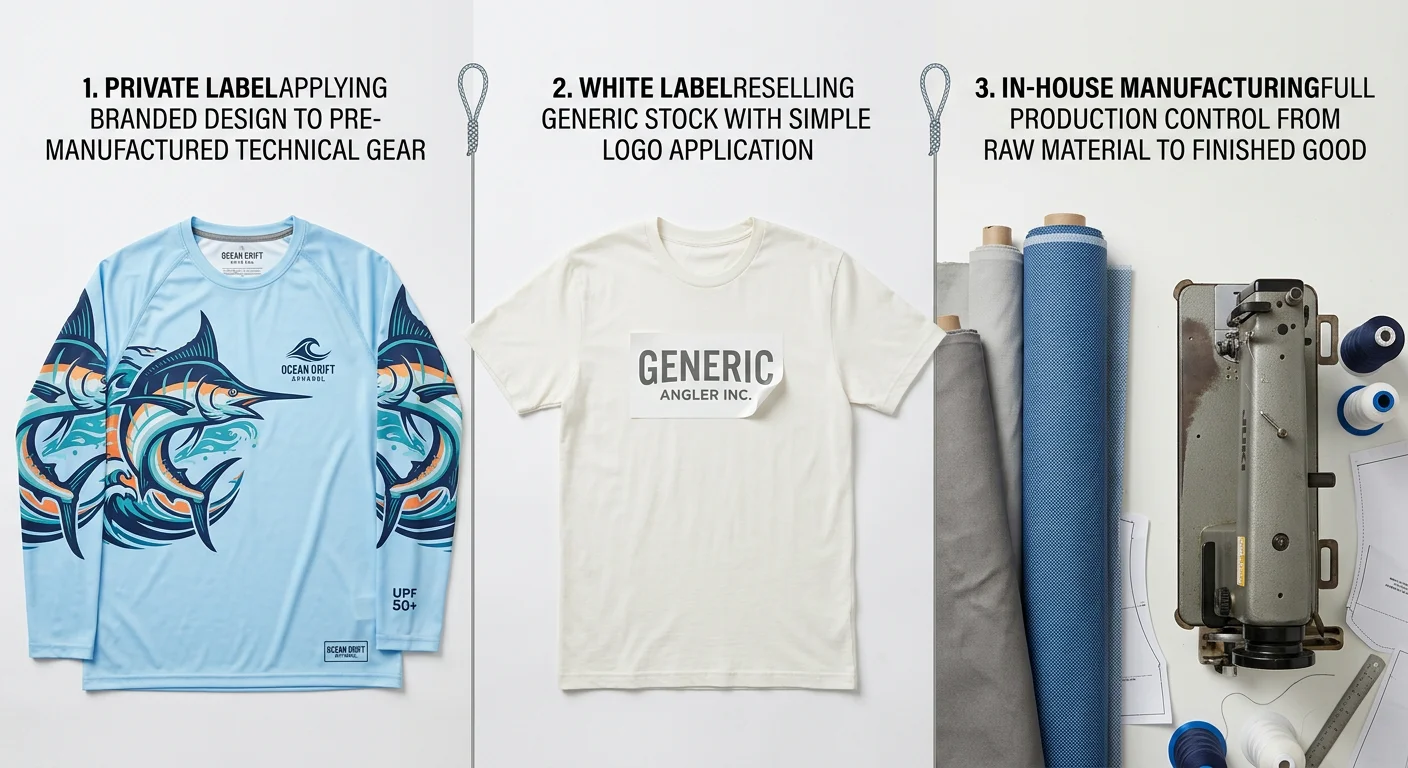
Three paths exist for getting your branded fishing apparel into the world. They are not equal — not in cost, not in control, and not in what they demand from you day-to-day. Choosing between them isn't about finding the "best" model in theory. It's about matching the right model to where your brand stands right now.
Private label means you own the brand identity outright. A third-party fishing apparel factory handles all physical production — sourcing performance fabrics, running dye-sublimation graphics, cutting, sewing, and attaching your custom labels. Your customer never sees the manufacturer's name. They see yours. That's the whole point.
White label (sometimes called generic OEM) works on a different foundation. You're placing your logo on a pre-existing, off-the-shelf garment. That same base blank may be sitting in another brand's store across town. Entry cost drops to $500–$2,000, and lead time shrinks to one to three weeks when stock blanks are ready. But here's the real trade-off: technical differentiation disappears. You can't choose UPF-rated fabric, flat-lock seams to cut casting abrasion, or ventilated mesh backs. The blank already exists. You get what it offers.
In-house manufacturing gives you full control over every fabric weight, dye lot, and seam construction decision. It also demands $150,000 or more in upfront capital for equipment, facility, compliance, and labor — plus three to six months before your first production run ships.
The table below lays out the differences side by side:
Dimension | Private Label | White Label | In-House Manufacturing |
|---|---|---|---|
Customization depth | High — fabrics, fits, UPF specs, sublimation graphics, packaging | Low — base styles plus logo/print | Full — every variable |
MOQ range | 50–500 pcs/style | 10–50 pcs | 1,000+ pcs |
Startup capital | $3,000–$15,000 | $500–$2,000 | $150,000+ |
Lead time | 4–8 weeks | 1–3 weeks | 3–6 months |
Gross margin potential | 50%+ typical | Lower — limited differentiation | High potential, heavy fixed costs |
Brand exclusivity | Yes — your design, your run | No — same blank sold to multiple brands | Yes — self-owned |
Why Private Label Wins for Performance Fishing Apparel
Generic blanks were never built to meet the technical demands of fishing apparel. Your customers spend eight hours on a tournament boat in direct sun. They judge your shirt on moisture management, UV protection, and whether the seams rub their casting arm — not just how your logo looks.
Private label lets you build exactly what that scenario requires:
UPF 50+ rated fabric (salt-resistant nylon or performance polyester)
Flat-lock seam construction to cut out casting abrasion
Rear mesh ventilation panels for airflow during long hours on the water
Moisture-wicking finishes with strong wash durability
Full custom sublimation of fishing apparel for all-over graphic programs
Private neck labels of fishing apparel, hang tags, and branded packaging that complete the shelf presentation
The production process is straightforward. You submit a product brief covering fabric type, UPF target, fit, seam construction, artwork, and label placement. The factory builds a sample. You review and approve revisions. Then bulk production runs under your brand name — not a public catalog item the manufacturer sells to anyone else.
The bottom line on model selection: Private label is the clear choice where technical differentiation and brand ownership both matter. White label fishing suits a fast test launch or simple logo merchandise — speed over uniqueness. In-house manufacturing is a later-stage move. It needs serious capital and production scale before it pays off.
End-to-End Production Workflow: Technical Specs & Timelines
Most startup guides skip this part: the gap between "I placed my order" and "my product is in my hands" is not a black box. It's a clear sequence of steps. Each step has a defined owner, a measurable output, and a deadline. Miss one, and everything downstream breaks.
For custom fishing apparel, the full concept-to-delivery window runs 8 to 10 weeks under normal conditions. Some complex programs push to 12. Knowing what happens inside those weeks — and why each phase takes as long as it does — separates brands that launch clean from brands that spend months chasing factories for updates.
Start by working backward from your delivery deadline. Lock that date first. Then build every phase against it.
Week 1–2: Requirement Alignment & Fabric Sourcing
The first decision shapes every decision that follows: what is this garment for?
An offshore charter shirt has different engineering demands than a freshwater bass tournament jersey or a cold-weather layering piece. Use case drives fabric weight, fit structure, and finishing chemistry. Get this wrong in week one, and it costs you four weeks in sampling revisions later.
For performance fishing tops built for sun exposure and heat, the standard benchmark is 100% polyester microfiber at 140–180 GSM with UPF 50+ certification . That's not a preference — it's the technical floor your tournament and charter customers will hold you to.
Lock these performance finishes at sourcing, not after:
DWR (Durable Water Repellency) for spray and splash resistance
Anti-odor treatment for long days on the water
Chlorine and salt-spray resistance for inshore and offshore environments
For cold-water outerwear, shift the spec to softshell laminates . Polyester microfiber won't work here.
Week 2: Vector Design & Print Engineering
Before a single yard of fabric gets cut, your artwork file must be production-ready. That means AI or EPS format, Pantone-matched, with full bleed margins sized for the sublimation press.
Map every placement before the sample cut. Rough positions won't hold up on the factory floor:
Chest and shoulder logo placement
Back sponsor block dimensions and bleed
Sleeve cuff accent panels
Hidden pocket gussets and zipper pull placement
On decoration method: dye sublimation is the right call for 100% polyester body graphics . It delivers colorfast, crack-resistant output that holds through heavy wash cycles. For collar patches or small structural details where abrasion resistance matters, embroidery is the better choice.
Week 3–4: Sampling & Functional Verification
This phase is where private label fishing apparel earns its premium over generic blanks — or fails to.
Build the first prototype and put it straight to work on angler mannequins with range-of-motion testing : casting posture, rod-handling reach, overhead movement. A shirt that fits well standing still can bind at the shoulder in a back-cast. Catch that here, not after bulk production.
Required performance tests at the sample stage:
Test | Standard | Target |
|---|---|---|
UV transmission / UPF verification | ASTM D6603 | UPF 50+ confirmed |
Colorfastness to washing | AATCC method | Pass |
Colorfastness to perspiration | AATCC method | Pass |
Shrinkage after 3 wash cycles | — | Under 3% |
Use the first sample round to tighten seam allowances , adjust sublimation saturation levels , and finalize the approved tech pack . Most programs run two to three revision rounds with locked checkpoints. Treat these checkpoints as hard gates. Informal feedback loops collapse timelines fast.
Week 5–8: Bulk Production & In-Line QC
With the approved tech pack confirmed, the factory moves to CAD pattern nesting . This step minimizes fabric waste before cutting begins. It's not optional — it's how professional moisture-wicking fishing apparel manufacturers control material cost at scale.
Construction specs that matter for performance fishing wear:
4-needle flatlock stitching on shoulder seams — this cuts casting abrasion at the seam line
Overlock finishing on all internal edges
Continuous sublimation tunnel curing for consistent print setting across the full run
QC checkpoints run in-line throughout production, not just at the end:
Size tolerance: ±1 cm across all measurements
Print alignment: ±3 mm from spec position
Thread pull-out testing on stress points
Fabric weight consistency checked against the sourcing spec
Week 8–9: Private Labeling & Fulfillment Prep
This step turns a finished garment into a branded product. The factory's generic neck tag comes out. Your woven or hot-stamp brand label goes in. Every garment leaving the production line carries your brand identity — not the manufacturer's.
Hangtags are not decoration. They're a communication tool. Print them with UPF rating explanation, care symbols, and a condensed brand story . For a custom logo fishing shirts program targeting tournament buyers or specialty retailers, that hangtag is often the first brand impression a buyer sees before placing a reorder. Make it count.
Final packaging goes into polybags or poly-mailers , followed by carton marking and palletization for 3PL intake or direct-to-consumer warehouse dispatch .
The Spec Set to Lock Before You Brief a Supplier
Don't enter a supplier conversation without these confirmed:
Spec Category | Standard Requirement |
|---|---|
Fabric | 100% polyester microfiber, 140–180 GSM, UPF 50+ |
Performance finishes | DWR, anti-odor, chlorine/salt resistance |
Artwork format | AI/EPS, Pantone-matched, with bleed margins |
Decoration method | Sublimation (body graphics), embroidery (patch areas) |
Testing protocols | ASTM D6603, AATCC colorfastness, <3% shrinkage at 3 washes |
QC tolerances | ±1 cm sizing, ±3 mm print placement |
A bulk fishing apparel supplier worth working with will recognize every line of that spec sheet. More than that — they'll ask sharper questions about it. How they respond to your specs is a direct signal of how reliable they'll be as a production partner.
MOQ Ranges & Startup Budget Framework
Numbers matter here. Not abstract numbers — the specific ones that tell you whether this business is within reach or just a good idea stuck inside an impossible budget.
Here's the real picture, built from 2024–2026 FOB benchmarks for performance fishing apparel made in China and Vietnam.
MOQ by Product Type
MOQs change a lot based on what you're building. Don't assume one number covers your whole lineup.
UPF sun shirts (partial sublimation or screen print)
Smaller sublimation vendors will work with you at 50–200 pcs per color . Larger export factories open at 300–500 pcs. For a first run, target flexible suppliers in that lower tier.
Full-sublimation fishing jerseys and tournament shirts
Team and club-focused dye-sub shops run at 30–100 pcs per design . Most allow mixed sizes within the minimum. That makes full-graphic tournament shirts one of the easiest entry points in custom fishing apparel.
Performance hoodies and softshell jackets
Plan for 150–500 pcs per style . Laminated technical jackets with DWR treatment and multi-panel construction can push to 500 pcs — sometimes higher. Fabric minimums drive that floor up.
Technical pants and bibs
Articulated knees, reinforced panels, and DWR finishes put most factories in the 200–300 pcs per style range. These are later-catalog products for most startup brands — not opening inventory.
What You Pay Per Piece
Product Type | Typical FOB Range | MOQ Range |
|---|---|---|
Basic UPF shirt | US$4.00–6.50 | 100–300 pcs |
High-spec sublimated tech shirt | US$7.50–12.00 | 50–200 pcs |
Tournament hoodie / charter jacket | US$14.00–22.00 | 150–500 pcs |
One solid reference point: a full-sublimation UPF 50 fishing hoodie from a China-based supplier costs around US$5.90 FOB at volume. A branded custom UPF shirt service lists retail starting at US$28.75 including printing — which puts FOB in the single digits at scale. The margin lives in that spread.
Startup Budget Framework: Three Realistic Scenarios
This table covers sampling, manufacturing, freight, duties, and basic branding — the full cost picture, not just the factory invoice.
Cost Component | Test Drop (~100 shirts) | First Collection (~300 mixed items) | Pro / Event Launch (~800 units) |
|---|---|---|---|
Sampling & Tech Pack | US$150–300 | US$300–600 | US$600–1,000 |
Bulk Manufacturing (FOB) | US$600–900 | US$2,400–4,200 | US$7,000–10,500 |
Freight & Duties | US$200–400 | US$600–1,200 | US$1,500–2,500 |
Branding & Packaging | US$100–250 | US$300–600 | US$800–1,500 |
Total Estimated | US$1,050–1,850 | US$3,600–6,600 | US$9,900–15,500 |
What each tier means for your business:
Test drop (~100 shirts): Run 100 basic UPF shirts at US$5.50 FOB. Add sampling, freight, and minimal branding — you're at US$1.2–1.8k total. This is a proof-of-concept launch, DTC only, no wholesale yet. You find out if your customer wants what you're building before you put serious capital at risk.
First real collection (~300 mixed items): A practical mix looks like 200 UPF shirts at US$5.50 FOB, 60 jerseys at US$9.50, and 40 hoodies at US$16. Weighted average FOB lands around US$7–8. This tier opens the door to small wholesale accounts alongside your DTC channel.
Pro launch (~800 units): 450 shirts, 200 jerseys, 150 hoodies or jackets. Weighted FOB around US$9–11. At this scale, you can support event sponsorship inventory, an e-commerce catalog, and early conversations with specialty retail buyers — all at once.
The Margin Reality
Branded performance fishing shirts retail at US$45–75 DTC . Fishing hoodies sit in the US$65–95 range. Wholesale runs 2.5–3.5x FOB . Distributors and retailers add 40–55% on top — landing retail at 3–4.5x FOB for most technical tops.
Run the math on a US$6 FOB UPF shirt:
Landed cost (FOB + freight + duties + packaging): US$7
DTC at US$55 → gross margin 87% before overhead
Wholesale at US$27–30 → brand gross margin 74–77% on landed cost
Go to the higher end — a US$11 FOB performance tech shirt with landed cost near US$13. DTC at US$75 still returns ~83% gross margin . Wholesale at US$32–38 delivers 60–66% .
The fishing apparel private label model generates real margin. But it only works if your FOB costs stay controlled and your retail positioning holds. Both depend on the supplier relationship you build — and that's the variable the next section addresses.
Five Commercial Drivers for Choosing Private Label Fishing Apparel
The brands winning in the fishing apparel market aren't just making great-looking shirts. They're making smart structural decisions from day one — and one decision keeps showing up: private label over every other path. Here are the five drivers that move the needle.
Driver 1: Access to Performance-Ready Fabrics — Without the R&D Bill
Building a technical fishing line from scratch means lab testing, mill minimums, and a development budget that can run $80,000–$150,000 before a single shirt ships. That's not startup math. That's enterprise math.
Private label flips the equation. Established OEM fishing clothing suppliers already maintain AATCC-tested UPF 50+ fabric programs — polyester and poly/spandex blends with moisture-wicking, quick-dry, and anti-odor finishes pre-qualified through rigorous testing. Factories like LeelineWear and dasFlow offer these performance fabrics as standard inputs. You pay per unit. Not per development cycle.
Look at the in-house alternative: 1,000–3,000 yards per color in mill minimums, UPF compliance testing under AATCC 183, colorfastness trials for seawater and UV exposure, and pilling assessments — all before production begins. Private label cuts that entire cost center. You redirect that capital toward what builds a brand: marketing, sponsorships, and channel development.
Driver 2: Speed to Market — Measured in Weeks, Not Quarters
Tournament schedules don't wait. Charter fleets need crew shirts before the season opens. A custom fishing shirt program that takes six months to materialize isn't a program — it's a missed opportunity.
Private label manufacturers are built for this pace. Lead times for 50–500 unit runs of sublimation fishing jerseys or tournament shirts land at 4–6 weeks from final art approval to delivery . That window covers design, full-sublimation print, cut-and-sew, neck-label application, and polybagging — not just printing.
Here's a real example. A charter fleet orders 120 crew shirts with sponsor logos and back graphics. The private label shop handles the full sequence in about five weeks. Dye sublimation on UPF fabric needs no pattern re-tooling. So artwork changes — sponsor blocks, numbering, custom logos — happen at the print stage. That flexibility makes rapid-response ordering a built-in advantage, not a lucky exception.
Driver 3: Technical Features That Support Premium Pricing
Generic blanks can carry a logo. They can't carry a $65+ retail price with any credibility.
Performance fishing apparel sold through DTC channels and specialty tackle retailers commands $45–$75 for UPF 50+ sun shirts and long-sleeve technical tops . Advanced styles exceed $80 when features like vent panels, flatlock seams, and raglan casting sleeves are part of the build. Entry-level screen-printed tees on non-technical blanks sit at $20–$30 — a completely different category.
Private label lets you build in the features that justify the higher price:
Hoods and thumb-holes for UV coverage without bulk
Rear mesh yoke panels for airflow on hot tournament days
Gusseted or raglan sleeves for unrestricted casting motion
Flatlock or anti-chafe seams for all-day comfort under PFDs and harnesses
The conversion data backs this up. Listings that lead with "UPF 50+ and moisture-wicking" outperform generic product pages by 30–45% in conversion rate in niche fishing e-commerce. That's driven by technical search intent and trust signals like AATCC certification references and pro-team association. Private label gives you full control over those claims because you built the spec. You own the story.
Driver 4: Test Small, Scale What Works, Kill What Doesn't
Inventory risk is the quiet killer of early-stage apparel brands. Commit to 2,000 units of a style that doesn't connect with your audience, and you'll spend the next eighteen months discounting your way out of a hole.
Private label fishing apparel programs are built to prevent that. Most suppliers support 50–100 unit test batches per style or colorway — small enough to run a real-world drop test across multiple graphics, regional themes, or seasonal prints. Tarpon art moves on the Gulf Coast. Redfish prints do better in the Carolinas. Small batch runs let you find that out without betting the brand on it.
A style that proves itself — 30–60 day sell-through is the signal — steps up to reorders of 300–500 units on the same fabric and pattern, with updated artwork. SKUs that don't move get cut. No mill contract. No fabric overhang. No committed cutting schedule.
The result: brands that shift from traditional bulk production to phased private-label micro-batches cut dead stock exposure by 60–75% . In a category driven by seasonal cycles and regional preferences, that inventory discipline isn't a nice-to-have. It's what keeps the business solvent through year two and three.
Driver 5: Channel-Ready Fulfillment Built Into the Production Process
Getting a garment made is one thing. Getting it into Amazon FBA, a 3PL warehouse, and a wholesale account at the same time — without a domestic repack operation cutting into your margin — is the challenge most first-time brands underestimate.
The right bulk fishing apparel supplier solves this at the factory level. Full-service OEM programs include:
Custom woven neck labels and branded hangtags with UPF rating explanations and care symbols
Individual polybagging with size stickers for retail rack and DTC fulfillment
UPC/EAN barcode printing and carton labeling for direct FBA or 3PL intake
Palletization formatted for Amazon FBA compliance or distributor receiving specs
The logistics impact is real. Factory-packed, FBA-compliant cartons shipped direct cut landed time to US warehouses by 10–14 days compared to shipping bulk to a domestic consolidator and then forwarding to FBA. For a brand launching around a tournament date or seasonal fishing window, two weeks matters.
The same private-label fishing shirt line — same factory run, same production event — ships to a Shopify-connected 3PL, enters Amazon FBA, and fulfills wholesale orders to marinas and tackle shops via master cartons with size runs. One production decision. Three revenue channels. That operational leverage is what separates a sustainable fishing apparel brand from one stuck managing logistics instead of building the business.
Supplier Vetting Checklist & Go-to-Market Decision Pathway
The wrong supplier doesn't just slow you down. It costs you a season.
Every dollar mapped out in your budget assumes a competent manufacturer on the other end. UPF claims can turn out unverified. A "35-day lead time" can stretch to 60. QC pass rates can be a complete mystery. Any of those breaks your margin model. So before you commit capital, here's how to vet the people you're betting it on.
The Five-Category Supplier Scorecard
1. Portfolio proof — outdoor and sportswear only
Generic apparel factories can print a logo. Performance fishing apparel takes a different level of craft. Ask for 3–5 recent production samples of sun shirts, hoodies, and technical jackets — with fabric spec sheets attached (fiber composition, GSM, UPF finish documentation). A factory that can't pull these on request is already telling you something important.
2. Production model and sublimation capability
Confirm whether the supplier runs full-package production (FPP) — they source fabric, print, cut, and sew under one roof — or CMT only. For custom logo fishing shirts and sublimation fishing jerseys, FPP is what you need. Ask for their equipment list: sublimation printer brands, maximum print width, heat press specs. Request print test samples. Check hard for banding, ghosting, or registration drift. Those defects don't get better at bulk scale. They get worse.
3. Certifications that are verifiable
Three documents are non-negotiable:
UPF 50+ test report from SGS, Intertek, or Bureau Veritas — call the issuing lab and confirm the report number yourself
OEKO-TEX Standard 100 certificate — check the issue date (reject anything older than 18 months)
BSCI, WRAP, or Sedex audit report — get the most recent full audit plus any corrective action plan
A supplier with UPF claims backed by a fabric mill's marketing sheet — no third-party lab, no accredited report — is a disqualification. Cotton/poly blends marketed as "UPF 50+" without certification fall in the same bucket.
4. MOQ and lead time commitments — in writing
For moisture-wicking fishing apparel and performance fishing wear branding programs, lock down these numbers:
Requirement | Target Benchmark |
|---|---|
Trial run MOQ | 50–150 pcs per style, no surcharge |
Sampling lead time | ≤10 working days from finalized tech pack |
Bulk lead time | ≤35 days from sample approval (peak season) |
On-time shipment rate | ≥95% over last 12 months |
A supplier requiring 1,000+ pieces for an initial sun shirt order — with no pilot option — isn't built for how a startup fishing clothing line needs to grow. Move on.
5. QC transparency
Request written QC SOPs. Ask for their declared AQL level — AQL 2.5 for major defects is the standard — and their historical pass rate. Target ≥95% . "We do 100% inspection" with no paperwork to back it up is not a quality system. It's a sales line.
Automatic Red Flags
Walk away if you see any of these during vetting:
No third-party UPF lab reports — supplier-claimed data only
Refuses a factory video walk-through or production floor photos
Price quotes with no line-item breakdown (fabric, print, sew, trim, packaging)
No written delivery commitment or on-time rate data
Cannot produce a business license or verified factory address
Go-to-Market Decision Pathway: Five Steps from First Contact to Seasonal Scale
Step 1 — Build your Factory Requirements Brief before outreach. Write down your product mix, target retail price, landed cost ceiling, required certifications, and MOQ range (trial: 50–150 pcs; scale: 300–500 pcs). Use it to filter every supplier before a single email goes out.
Step 2 — Order fit samples and print test samples at the same time. Measure both against your tech pack. Check fabric hand-feel, sublimation registration, and color accuracy. Pull UPF and colorfastness lab reports for the same fabric lots right then — don't push that to bulk.
Step 3 — Run a 50–150 piece pilot order. Lock in clear pricing, AQL standards, and private labeling terms in writing before the PO goes out. Pay close attention to how the supplier communicates under production pressure. That behavior grows with order size.
Step 4 — Measure sell-through velocity at 4–8 weeks post-launch. Styles that convert get scaled to 300–500 units. Styles that don't get cut — no mill contract, no fabric overhang, no sunk cost spiral.
Step 5 — Lock seasonal fabric allocation with your top one or two suppliers. Negotiate rolling POs tied to your demand forecast, seasonal UPF fabric reservations for spring and summer drops, and documented price stability bands. Score each production run on quality, delivery, communication, and cost adherence. Keep those scores updated every run.
The bulk fishing apparel supplier relationship that builds over time — where they hold fabric for you, flag lead-time risks ahead of schedule, and improve QC run over run — comes from this kind of structured, documented process. It doesn't happen by accident. It happens because you showed up knowing what you needed and how to measure it.
Conclusion
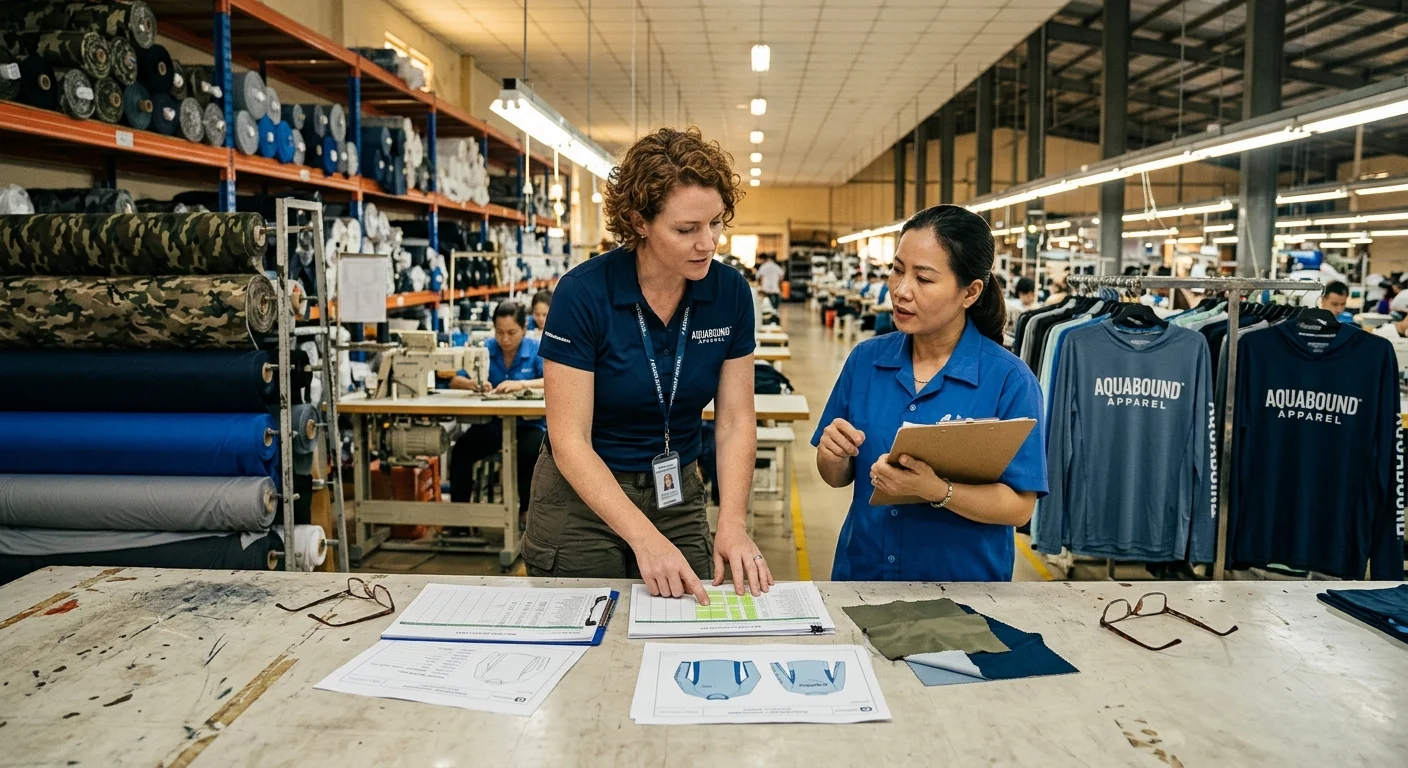
The fishing apparel market doesn't reward hesitation. It rewards brands that show up with the right product, the right story, and the ability to deliver both.
Private label fishing apparel isn't a shortcut. It's a real business strategy. You're not just putting a logo on a shirt. You're building a brand on top of proven UPF technology, performance-tested fabrics, and a supply chain that took years to build. Your job is to own the customer relationship and shape the brand identity. Let the manufacturing side handle the rest.
You've read this far. That means you're past the "wondering" phase. You're now in the "deciding" phase.
So here's your next move: grab the supplier checklist from this guide. Shortlist two or three bulk fishing apparel suppliers . Then request samples. Real decisions start with real samples — not spreadsheets.
Your brand doesn't need a factory. It needs a fishing shirt worth wearing.