Most fishing apparel wholesale buyers sourcing fishing sun hoodies make the same costly mistake. They evaluate samples like end consumers — touching the fabric, checking the color, maybe pulling at a seam — then place a 300-unit order based on gut feel. Six months later, they're sitting on dead inventory. The UPF 50+ rating turned out to be a marketing label, not a certified spec. Or the fit didn't match what tournament anglers wear on the water.
This guide cuts through that guesswork. It's built on hard-won sourcing experience across performance fishing apparel wholesale. What you get is a procurement decision framework with four clear pillars:
Fabric specifications you can verify with numbers
A feature priority matrix ranked by angler-validated conversion data
A tiered cost-margin structure from $3 to $15 landed
A fishing sun hoodies supplier vetting protocol that protects your capital before you commit to a single unit
Quantifiable Fabric & UPF Specification Framework for Bulk Orders
UPF ratings on a spec sheet mean nothing without the numbers behind them. Here's what each label level translates to in real UV protection:
UPF 15–24: 93.3–95.9% UV blocked — "good" by standard classification, but below the acceptable threshold for serious fishing apparel
UPF 25–39: 96.0–97.4% UV blocked — "very good," workable for volume club orders
UPF 40–50+: 97.5–98%+ UV blocked — "excellent," the minimum to accept for any mid-range or premium line
For bulk orders, map these ratings to four spec tiers:
Order Tier | Minimum UPF | UV Blocked | Use Case |
|---|---|---|---|
Entry / Volume Club | ≥30 | ≥96.7% | Budget club programs, high-turnover SKUs |
Mid-Range Performance | ≥40 | ≥97.5% | Core fishing hoodie line |
Premium / Charter Fleet | 50+ | <2% UV transmittance | Guide services, tournament sponsors |
High-Heat Summer Drops | 30–40 | 96–97.5% | Prioritize airflow alongside protection |
GSM: The Number Suppliers Hope You Won't Ask About
Fabric weight — measured in grams per square meter (GSM) — is the most underused spec in fishing apparel wholesale. Most buyers never include it in their RFQ. That's the direct reason they end up with hoodies that test at UPF 18 instead of the claimed 50+.
Here's the baseline drawn from UV-protective textile data:
A plain white cotton T-shirt reaches UPF 5–7 . Generic summer tees often land at UPF 6–20 . Keep that in mind the next time a Sun fishing Hoodies supplier shows you a "sun protective" swatch.
Research puts ≈163 g/m² as the minimum weight to reach UPF >15 with consistency. For fabrics labeled "guaranteed protective," that threshold climbs to ≈235 g/m² .
High-density UPF 50+ polyester/nylon fabrics tend to run 150–260 GSM , depending on garment category.
Practical GSM targets by tier:
UPF ≥30 club/volume: target ≥140–160 GSM, tighter knit, darker colorways — no elastane needed
UPF ≥40–50+ mid/premium: target ≥160–200 GSM, plus UV-absorber treatment or pigment loading
High-heat lightweight drops at UPF 30–40: 110–140 GSM works, but you must compensate with darker yarn, UV-additive finish, and careful color selection
The Four Variables That Drive UPF
Suppliers will show you a UPF number. Your job is to know what's behind it — because these four variables are where quality shortcuts hide:
Weave/knit density (cover factor): This is the dominant driver. A denser, less open structure blocks more UV regardless of fiber type. Open-structure knits need chemical compensation to reach UPF 30+.
Color depth: Darker shades outperform light or white fabrics at the same GSM — by a clear margin. Spec'ing a "white fishing hoodie" at UPF 50+? Demand documented test results, not just a supplier's assurance.
Stretch content: Spandex opens the knit structure under tension. A fabric testing at UPF 40 flat may drop to UPF 28 at 15% stretch. Always require wet and stretch-condition test data for any polyester spandex blend fishing hoodie .
Wet state: Moisture can cut UPF protection by up to 50% across many fiber types. For anglers wearing a long sleeve fishing hoodie in spray, sweat, or rain, this isn't a footnote — it's a safety variable.
Fabric-Specific Spec Lines You Can Drop Into Any RFQ
Stop writing vague purchase orders. Use these spec lines when sourcing:
Entry-level (100% poly, club programs):
"100% polyester knit, 150 ±10 GSM, dyed medium/dark, tested UPF ≥30 (dry & wet) per AS/NZS 4399."
Mid-range performance (poly/spandex blend):
"Poly/spandex knit (90/10), 165 ±10 GSM, UV-absorber fiber, UPF ≥40 dry, ≥30 wet under 15% stretch; report UVA/UVB blocking rates as separate values."
Premium/charter fleet (UPF 50+ certified):
"High-density nylon/poly woven, 190 ±10 GSM, fiber-integrated UV absorber, UPF 50+ (UVA ≥97.5%, UVB ≥98% block), rating maintained ≥40 washes."
High-heat summer drop (open-structure, max breathability):
"Open-structure warp knit, 125 ±5 GSM, dark color, UV-absorber finish, UPF ≥30 dry; buyer acknowledges airflow trade-off."
What to Demand in Every Test Report
A UPF claim without documentation is just marketing copy. Sourcing any UPF 50+ hoodie fabric for bulk order means requiring your supplier to provide test reports that cover all of the following:
Standard used: AS/NZS 4399, ASTM D6603, EN 13758-1, or AATCC TM183 — accept any of these, reject anything else
Condition sets: dry state, wet state (150% ±5% moisture content), and stretched condition where spandex is present
Test atmosphere: 21°C ±1°C, 65% ±2% RH, minimum 4-hour conditioning before measurement
Measured outputs: UPF value, plus separate UVA transmittance/blocking rate and UVB transmittance/blocking rate
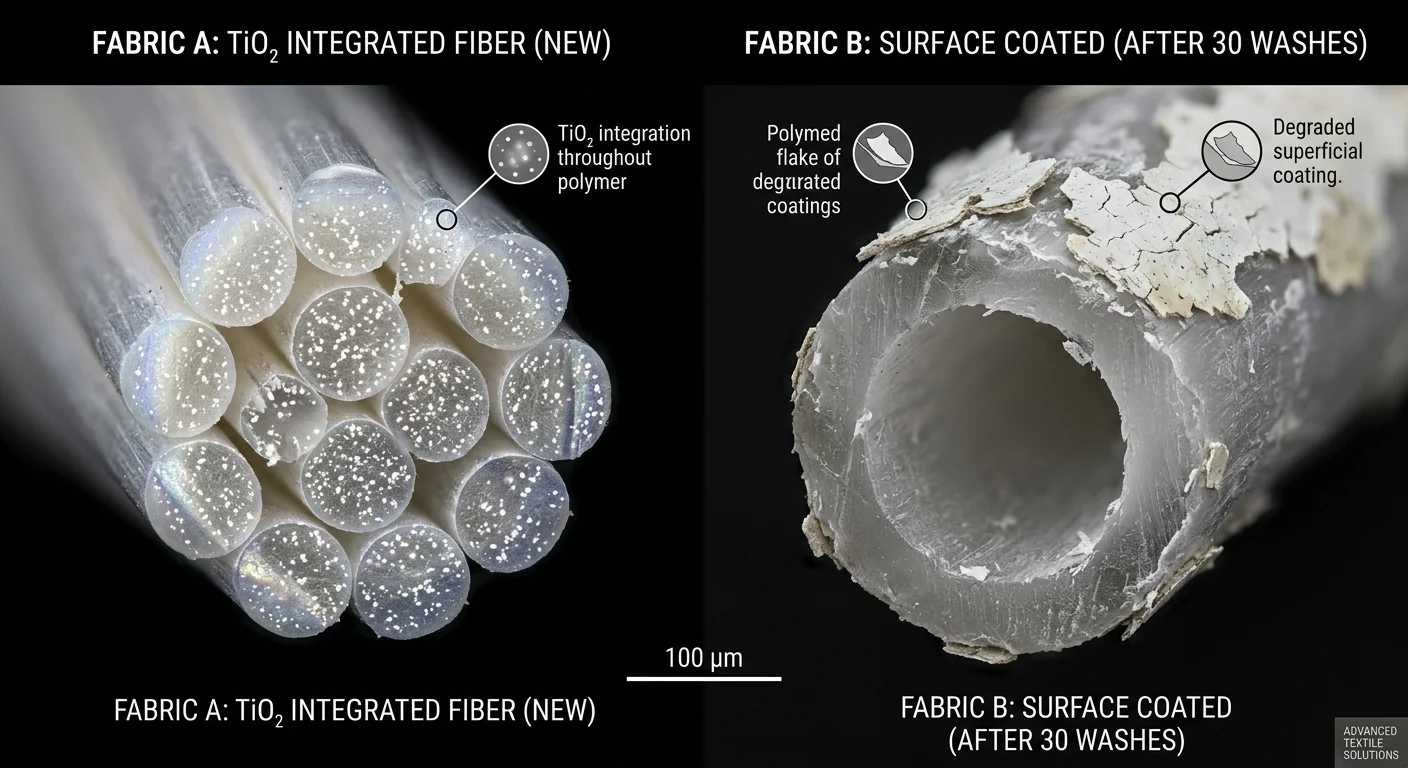
Durability data: Number of wash cycles over which the UPF rating holds — finish-based treatments generally document 40+ washes; fiber-integrated UV absorbers are permanent
Sourcing for EU markets or any charter operation with PPE compliance requirements? Also request the full technical file, including an EU Declaration of Conformity.
One rule of thumb worth holding onto: fiber-integrated UV protection always outperforms topical finish-based protection for long-term durability. A hoodie treated with a UV-absorber coating will break down with washing. A garment built from TiO₂-embedded or solution-dyed UV-blocking fiber holds its rating for the life of the garment. That gap matters a great deal — your retail customers may wear the same anti-UV outdoor hoodie 40 times a season.
Angler-Validated Feature Priority Matrix: High-Conversion vs Premium Add-Ons
Feature selection is where wholesale margins are won or lost — not in price negotiation.
Overspec your entry line with premium add-ons and your unit cost climbs past what your market will bear. Underspec it and you're stocking hoodies that experienced anglers reject on sight. The matrix below comes from real user behavior data across tournament, charter, and recreational fishing segments. Use it to make deliberate spec decisions, not catalog-browsing ones.
The Core Line: Seven Features That Close Sales
These are the non-negotiables. Every long sleeve fishing hoodie in your core range needs all seven. Leave one out and you're not selling to serious anglers — you're selling to campers.
1. UPF 50+ rating (verified, not labeled)
Already covered in the fabric section. The key point: anglers treat UPF 50+ as the baseline. Anything below it signals a budget product — no matter how the marketing frames it. UPF 50+ blocks 98%+ of UVA/UVB. That's the number your retail buyer will repeat to their customer.
2. Thumbhole cuffs
This is the top-performing functional detail in performance fishing apparel wholesale . Thumbholes anchor the sleeve over the back of the hand during casting. Without them, a long sleeve rides up within minutes on the water. Anglers know this. A sample that arrives without thumbholes tells the buyer the supplier doesn't understand the use case.
3. Integrated neck gaiter or fold-down collar
Full ear and neck coverage is non-negotiable for anyone fishing in mid-day sun. A breathable fishing shirt with hood that leaves the neck exposed defeats its own purpose. The mechanism matters less than the result — a built-in gaiter, foldable high collar, or hood with chin extension all work. Just make sure the protection is there.
4. Cap-compatible structured hood
The hood must fit over a ball cap. This sounds obvious. It isn't — most fashion hoodies are cut too narrow. Spec an oversized structured hood with a cinch toggle that turns with the wearer's head. Laminated-visor hoods that hold their shape in wind are the better version. Both belong in a sun protection factor clothing line targeted at anglers.
5. At least one zippered chest or seam pocket
Pocket placement is a trust signal for experienced anglers. A single secure zip pocket — chest or side seam — is the minimum acceptable spec. It needs to clear a PFD harness and not interfere with a rod hold. Velcro closures work as a secondary option, not a primary one.
6. Underarm or back mesh ventilation panels
Mesh ventilation panels in the back yoke or underarm gussets cut on-water heat buildup by a measurable margin. One source puts performance moisture wicking fishing apparel at a 4°F lower perceived heat versus cotton equivalents — ventilation panels drive that difference. For any breathable fishing shirt with hood , this belongs in the core line, not the upgrade tier.
7. Quick-dry, abrasion-resistant synthetic blend
Performance fishing apparel dries sweat 60% faster than cotton in field conditions. The fabric blend behind that number is a polyester or polyester spandex blend fishing hoodie construction with a tight, snag-resistant knit. Abrasion resistance matters for deck work and brush contact — call this out in your RFQ spec.
The Premium Add-On Tier: Only Where Margin Supports It
These features have real functional value. They're also real cost drivers. Add them to a premium SKU or charter-fleet line — not your volume club program.
Feature | Why It's Premium | When to Add It |
|---|---|---|
Waterproof-breathable 2.5–3 layer shell | Adds $4–7 to unit cost; requires taped seams | Foul-weather or PNW charter lines |
Laminated visor hood with cinch/toggle | Higher tooling and material cost | Tournament or guide-service tiers |
DWR coating | Maintenance-intensive; degrades with washing | Justified at $12+ retail positioning |
Salt-resistant zippers, snaps, drawcords | YKK AquaGuard adds ~$0.80–1.20/unit | Saltwater-specific SKUs; worth it there |
Reinforced elbows and seat stitching | Adds construction time | Offshore or kayak-targeted lines |
Tool loops / D-rings | Niche but appreciated by guides | Guide-service or fly-fishing segment |
Multiple waterproof pockets | Significant pattern cost | Offshore or coastal primary customer |
Anti-odor treatment | Marketing value is high; retention varies | Premium positioning with documented wash-cycle data |
High-back kayak/PFD compatibility | Requires pattern redesign | Kayak fishing segment |
The logic is simple: don't pay for premium add-ons your core buyer won't notice. A recreational angler buying a club-program quick dry fishing hoodie at a $28 retail price point doesn't need DWR coating or salt-resistant YKK hardware. A charter captain outfitting a 12-person guide fleet does.
The Practical Checklist Before You Approve Any Sample
Run every sample through this before you release a purchase order:
Thumbhole present and functional under casting motion
Hood fits over a standard 58cm ball cap with cinch closed
Neck gaiter or fold-down collar covers ear base to chin
Zippered pocket clears a standard PFD harness
Ventilation panels present at underarm or back yoke
Fabric stretch test: no visible knit gap at 15% extension
Wet-condition test data included in supplier documentation
UPF rating supported by AS/NZS 4399 or ASTM D6603 test report
A supplier that can't pass all eight checkpoints isn't ready to talk price.
Wholesale Pricing Architecture & MOQ-Tiered Margin Benchmarks
The margin math on fishing sun hoodies looks simple at first. Then a supplier sends you a quote sheet with no MOQ structure, no volume breaks, and one flat "wholesale price." That number tells you nothing about what happens at scale. That's not a pricing architecture. That's a negotiating trap.
Here's the structure that works.
The Three-Tier Cost Stack
Every purchasing decision in performance fishing apparel wholesale starts with landed COGS — not FOB price. Landed means FOB plus freight, duties, and any compliance testing you've paid for. Build your pricing upward from that number.
The industry-standard formula:
Wholesale Price = Landed COGS ÷ (1 − Target Wholesale Margin)
Target wholesale margin in this category runs 40–50% contribution , depending on tier. Your retail accounts — specialty fishing shops, regional chains, online marketplaces — need 50–60%+ gross margin to reorder. So MSRP needs to land at 2.2–2.5× your wholesale price . Work backward from that math before you approve a single sample.
Here's what the three operational tiers look like in real numbers:
Tier | Landed COGS | Target Wholesale Margin | Wholesale Price | MSRP Range | Retailer Margin |
|---|---|---|---|---|---|
Entry / Club Volume | $3–$6 | 40–45% | $5–$11 | $18–$24 | 50–55% |
Mid-Range Performance | $7–$10 | 45–50% | $13–$20 | $28–$38 | 55–60% |
Premium / Charter Fleet | $11–$15 | 50–55%+ | $22–$33 | $45–$65+ | 60–65% |
The entry tier — 100% polyester, 120–140 GSM, basic UPF 30, one-color print — puts MOQs at 200–500 units per colorway . This is the volume club program tier. Margin runs thinner, but inventory turns faster.
The mid-range tier — poly/spandex blend, 140–160 GSM, UPF 40–50+, sublimation-ready — drops MOQ to 100–300 units per design . The higher unit price supports the smaller run. This is your core long sleeve fishing hoodie line.
Premium technical construction — nylon/poly, laser-cut or bonded seams, certified UPF 50+ — can go as low as 50–150 units per colorway . The higher per-unit value supports the factory's economics even on short runs.
MOQ Volume Breaks and What They Cost You
A well-structured supplier offers three to four volume discount bands off their base wholesale tier. Here's how the math breaks down:
Tier 2 (2–3× base MOQ): expect a 3–7% unit price reduction — the supplier absorbs ~2–3 margin points in exchange for better freight consolidation
Tier 3 (≥$10–15K order value): an additional −1.5% is the standard B2B benchmark; some suppliers stack this with prepayment incentives
Top-tier distributor pricing (5–10× base MOQ): cumulative discounts reach 5–12% off base wholesale — this is where you start protecting margin on a quick dry fishing hoodie SKU with high reorder velocity
Payment terms move price too. Net-60 terms add +2–3% to unit cost versus net-30. Prepayment pulls back 1–2% off standard pricing. On a 300-unit order at $12 wholesale, that 2% swing equals $720 in recovered margin. Structure that into your supplier agreement from day one.
Customization Cost Add-Ons: The Budget Leak No One Talks About
Branded lightweight sun protective clothing programs always involve custom work. Most buyers underestimate how fast those costs stack up:
Screen print (1–2 color): $0.50–$1.20/unit at 200+ pcs
All-over sublimation: $1.50–$3.00/unit setup cost spread across units; cheaper at 200+ units
Embroidered logo (chest): $1.00–$2.50/unit depending on stitch count
Custom sun fishing hoodies woven labels / hang tags: $0.20–$0.60/unit — easy to miss at the RFQ stage
Salt-resistant YKK AquaGuard zippers: +$0.80–$1.20/unit over standard hardware
Run every one of these through your margin formula before placing the order. Not after the invoice arrives.
The Validation Test Before You Commit Capital
Before releasing a purchase order at any tier, run one final check: wholesale price should equal 50–60% of your intended MSRP. Your MSRP math requires wholesale below 50% of retail? Your COGS is too high, your retailer's margin expectations are off, or both. A supplier quoting $11 FOB on a UPF 50+ hoodie fabric construction you need to retail at $28 is not a viable SKU — the numbers don't clear. Fix the spec, renegotiate the COGS, or reprice the retail. Don't force the math to work on paper and count on the market to meet you there.
Supplier Qualification Protocol & Common Procurement Pitfall Prevention
Three documents separate a reliable factory from a liability: a signed specification sheet, a third-party UPF test report, and a lot-level traceability record. A supplier who can't produce all three before you cut a purchase order isn't a qualified vendor. That's an unverified promise.
Here's how to build a repeatable vetting process that protects your capital at every stage.
The Non-Negotiable Document Stack
Get this minimum document pack before any factory discussion moves to pricing:
Business license and factory registration — confirms legal operating status
ISO 9001 or equivalent QMS certificate — shows documented quality systems, not just verbal assurances
Third-party UPF test reports to AATCC 183 or AS/NZS 4399 — no internal estimates, no visual assessments, no exceptions
Mill invoices and fabric composition certificates — cross-check polyester/spandex ratios against your spec within ±2% tolerance
Past third-party audit reports (quality, social, environmental) — a pattern of compliance matters more than one clean result
Any supplier who pushes back on these documents is telling you something important. Listen to it.
The Three-Phase Qualification Protocol
Don't approve a supplier after one clean sample. Run them through three sequential gates:
Phase 1 — IQ (Initial Setup): Confirm all specs, contracts, and quality agreements are signed. Check that COAs, test reports, and shipment documentation transfer in practice — not just on paper.
Phase 2 — OQ (Operational Qualification): Run pilot purchase orders. Track on-time delivery, defect rate, and test compliance. Measure how fast they respond to deviations. A supplier who responds slowly to a small problem will handle a large one even worse.
Phase 3 — PQ (Performance Qualification): Check consistency across three to five back-to-back shipments under normal operating conditions. Grant full approval only after KPIs clear your thresholds — target OTD ≥95% and defect rate ≤1%.
Jumping straight to bulk production without finishing OQ is the single most common capital-loss event in performance fishing apparel wholesale .
Traceability as a Hard Filter
Lot-level traceability isn't optional for UPF 50+ hoodie fabric sourcing. It's a qualification gate.
Require a system that links mill lot → fabric roll ID → cutting lay plan → sewing bundle → finished garment lot. Then test it. Pick three finished lots at random and trace each one back to mill documentation. Any lot that breaks the chain means that supplier fails — no matter how good the samples look or how low the price is.
Here's why this matters. A UPF failure post-delivery forces a hard choice. With traceability, you can isolate the affected units. Without it, you absorb a full recall.
Four Procurement Pitfalls and Their Controls
Capacity overcommitment: Suppliers often overstate output. Ask for documented production figures by style each month. Cross-check those numbers against historical PO data from other clients. For seasonal programs targeting charter fleets or tournament cycles, confirm a minimum capacity of ≥10,000 units of relevant styles per month — get it in writing.
UPF claim inflation: Never accept a supplier's "estimated UPF" or internal lab result for anti-UV outdoor hoodie construction. Require annual re-testing of at least one colorway per fabric group. Put test frequency requirements in the quality agreement itself — not just the RFQ.
Documentation drift: Use one centralized platform to store all supplier specs, COAs, test reports, and audit results. Scattered documents across email threads create compliance gaps. Those gaps show up during chargebacks or product liability events — exactly when you can least afford surprises.
No change control: Require a documented process for how pattern or fabric changes get requested, approved, and tracked. A supplier who can change your polyester spandex blend fishing hoodie spec mid-production — without a formal sign-off — will ship something different from what you approved. It's not a question of if. It's a question of when.
The Ongoing Scorecard
Qualification isn't a one-time event. Keep an approved supplier list. Make sure all purchasing routes through it. Run a formal re-qualification every two to three years. Add unannounced audits for any vendor you classify as high-risk.
Score every shipment on: spec compliance rate, COA completeness, UPF test validity, audit score trend, and on-time delivery percentage. Suppliers whose scores drop get a formal corrective action plan before the next PO — not after the inventory problem lands in your warehouse.
Conclusion
A profitable fishing apparel line or a warehouse full of dead inventory — the gap between them comes down to one thing: buying with data, not instinct.
You now have the framework. You know which UPF 50+ hoodie fabric specs hold up under third-party testing. You know which angler-validated features drive repeat wholesale orders. You know where the margin lives across the $3–$15 price architecture. You also know the red flags — the profitable fishing apparel supplier shortcuts and spec sheet illusions that eat into your profitability before the first unit ships.
So here's your next move:
Build a shortlist of three to five Sun fishing Hoodies suppliers
Run the qualification protocol against each one
Request physical samples before committing to any MOQ above 100 units
Let the fabric weight, stitch density, and UPF certification documents speak for themselves. Don't rely on a sales pitch.
In this market, winning buyers aren't chasing the lowest price. They know what they're paying for — down to the last detail.